
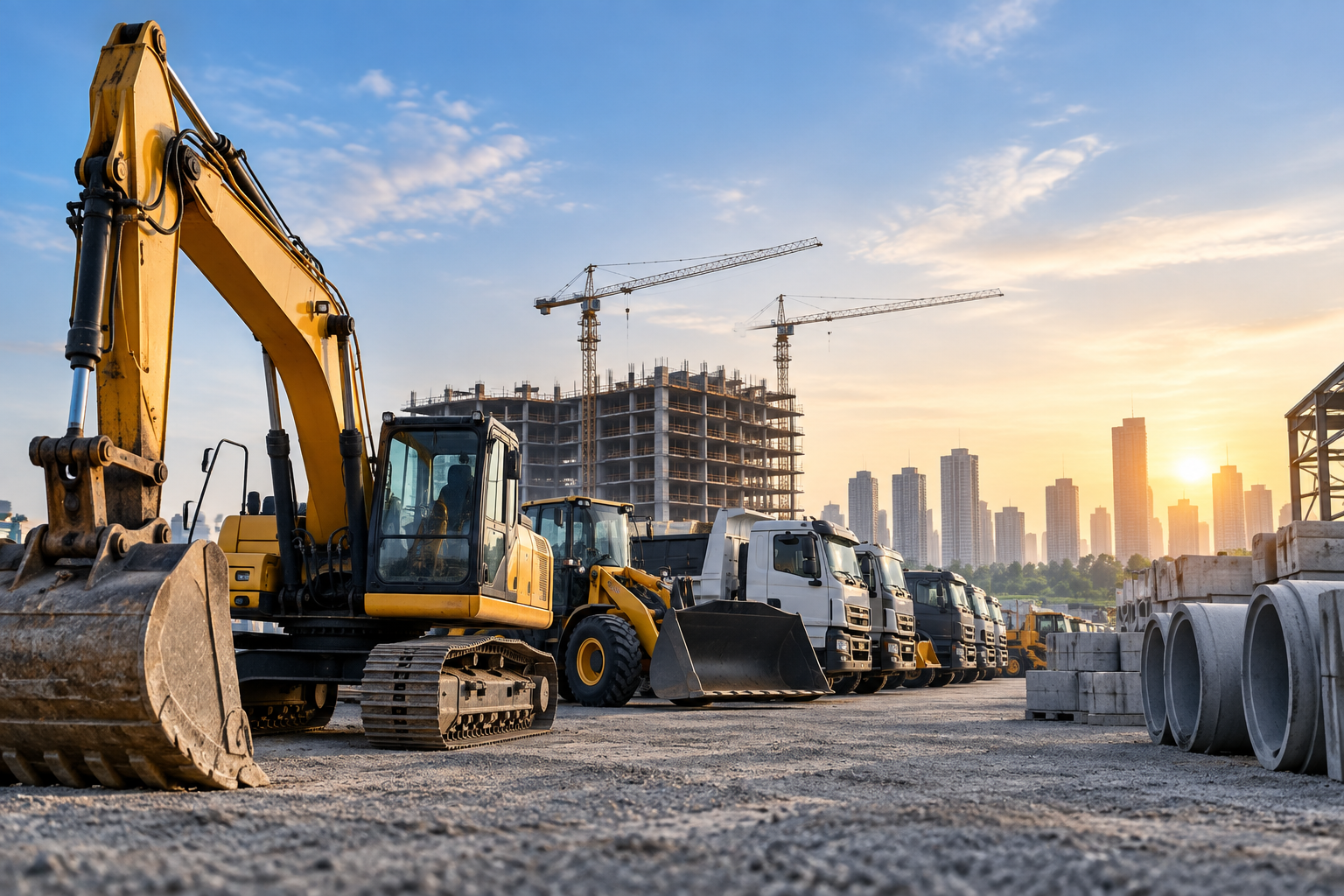
India's capital-investment cycle is creating sustained demand for productive assets, making equipment finance an increasingly important part of business-cycle financing.
India is entering an important phase of capital investment. Infrastructure development, manufacturing expansion, logistics, construction, renewable energy and industrial automation are creating sustained demand for productive assets.
This is creating a significant opportunity for equipment finance.
Equipment finance is no longer simply a loan against a machine. Increasingly, it is becoming a financial solution that connects asset acquisition, business cash flow, working capital and future expansion.
India’s Equipment Finance Opportunity
The strongest structural driver is India’s continuing capital-expenditure cycle.
Under the Union Budget 2026–27, India's public capital expenditure has been increased to approximately ₹12.2 lakh crore. This continued public investment is expected to support infrastructure and productive-capacity expansion.
The capital-goods segment is also showing signs of strengthening, indicating continued demand for machinery and technologically advanced equipment.
This matters for lenders because every new productive asset potentially creates a financing requirement.
Construction Equipment: A Leading Indicator
Construction equipment remains one of the most visible segments of equipment finance.
After a subdued FY2026, the Indian construction-equipment industry has raised its FY2027 domestic growth expectation to approximately 9–12%, supported by improving infrastructure-project execution.
The message for lenders is important:
Short-term equipment demand can fluctuate, but the underlying financing opportunity is linked to India’s longer-term infrastructure and industrial-capacity cycle.
Equipment Finance Is Bigger Than Construction Equipment
The opportunity extends well beyond JCBs, excavators and cranes.
Major equipment-finance opportunities include:
- CNC and VMC machines
- Manufacturing machinery
- Packaging machinery
- Printing equipment
- Plastic-processing machinery
- Textile machinery
- Material-handling equipment
- Warehouse and logistics equipment
- Medical equipment
- Renewable-energy equipment
- Mining equipment
- Construction equipment
- Food-processing machinery
- Automation and robotics
- Industrial testing and measuring equipment
The Important Shift: From Asset Finance to Business-Cycle Finance
Traditionally, equipment finance has been evaluated through:
Borrower + Asset + Margin + Collateral + Credit History
The next generation of equipment finance can increasingly be evaluated through:
Asset + Cash Flow + Utilisation + Business Transactions + Customer Orders + Banking Data
A machine does not generate repayment capacity merely because it has collateral value.
It generates repayment capacity because the machine is productive.
Therefore, lenders need to understand:
- What does the equipment produce?
- How much is the equipment utilised?
- Who are the customers?
- What is the order book?
- What is the expected cash flow?
- What is the replacement value?
- What is the resale value?
- What happens if utilisation falls?
- What working capital is required after the machine is installed?
Equipment Finance + Working Capital
This is perhaps the most underappreciated opportunity.
A manufacturer purchasing a ₹1 crore machine may simultaneously require:
Equipment Finance → Insurance → Installation → Raw Material Finance → Working Capital → Invoice Discounting → AMC → Expansion Finance
Therefore, the financial partner who understands the entire business cycle can potentially create substantially more value than someone offering only a term loan.
Example
A manufacturing company purchases a ₹1 crore CNC machine.
Instead of looking at the transaction simply as:
₹1 crore machine = equipment loan
the broader opportunity could be:
Machine Finance + working capital + insurance + future receivables finance + expansion finance.
The exact requirement will depend on the customer's financial profile, margin, cash flows and lender policy.
Used Equipment: Another Major Opportunity
Used machinery can create an attractive financing opportunity for MSMEs because the initial investment is lower and businesses can acquire productive capacity faster.
However, used-equipment financing requires stronger due diligence.
Important parameters include:
Age → Ownership → Valuation → Machine condition → Usage hours → Maintenance history → Resale market → Insurance → Location
Technology Will Change Equipment Underwriting
Future lenders can potentially combine:
GST data + Bank statements + ERP data + Bureau data + Order book + Machine utilisation + Invoice data + Payment behaviour
with AI-based early-warning systems.
This can help lenders identify changes in:
- Sales
- Collections
- Inventory
- Customer concentration
- Machine utilisation
- Receivable ageing
- Bank-credit behaviour
The result could be a transition from periodic credit assessment to continuous credit monitoring.
Why Banks and NBFCs Should Pay Attention
Equipment finance can offer lenders several opportunities:
- Productive end use — funding is linked to an identifiable business asset.
- Cross-selling potential — equipment customers frequently require working capital and other financial products.
- Repeat business — successful businesses may return for additional machinery and expansion.
- Data-rich underwriting — equipment finance can increasingly be supported by operational and transactional data.
However, lenders must continue to assess borrower cash flow, asset quality, concentration, industry cyclicality, resale value and repayment capacity.
The Future of Equipment Finance in India
The next phase is likely to be less about simply financing the purchase of equipment and more about financing productive capacity.
The financing ecosystem could increasingly look like:
Equipment Manufacturer
↓
Dealer / Distributor
↓
Equipment Finance
↓
Insurance
↓
Working Capital
↓
Invoice / Receivables Finance
↓
Expansion Finance
This creates an opportunity for banks, NBFCs, fintech platforms and financial consultants to move from product selling to business-cycle financing.
What This Means for MSMEs
For an MSME, the right financing structure can determine whether a machine becomes an asset or a burden.
The objective should therefore not simply be:
“Get the cheapest equipment loan.”
It should be:
“Structure the financing so that the asset generates enough cash flow to comfortably service the debt while supporting the company's working-capital cycle.”
That is the real purpose of equipment finance.
How Kratu Fin Can Help
At Kratu Fin, we look at equipment finance from a broader business perspective.
Our approach is not limited to arranging finance for the machine. We aim to understand the business, cash flow, equipment requirement and overall funding cycle before identifying an appropriate financing structure.
Depending on eligibility and lender policy, solutions may include:
- New equipment finance
- Used machinery finance
- Manufacturing machinery finance
- Construction equipment finance
- Working-capital finance
- Invoice / bill discounting
- Supply Chain Finance
- Business loans
- Loan against property
- Equipment refinance / balance transfer
Looking to Finance Your Next Equipment Purchase?
If your business is planning to purchase CNC/VMC machinery, manufacturing equipment, packaging machinery, construction equipment, material-handling equipment or other productive assets, speak with the Kratu Fin team before finalising your financing structure.
Let us evaluate the equipment requirement, business cash flow and working-capital cycle and help identify suitable financing options from our lending network.
📩 Contact Kratu Fin today for an equipment-finance assessment.
Kratu Fin — Simplifying Finance, Supporting Growth.
Conclusion
India's infrastructure and manufacturing investment cycle is creating a strong structural foundation for equipment financing.
But the biggest opportunity may not be the equipment loan itself.
It is the ecosystem surrounding the equipment:
Equipment Finance + Working Capital + Receivables Finance + Insurance + AMC + Expansion Finance
The future question for lenders is therefore not:
“Can we finance the equipment?”
It is:
“Can we understand the cash flow generated by the equipment and finance the entire business cycle around it?”
That shift—from asset financing to business-cycle financing—could define the next phase of equipment finance in India.
Financial products, eligibility, pricing, documentation and approval are subject to the policies and assessment criteria of the respective financial institution.